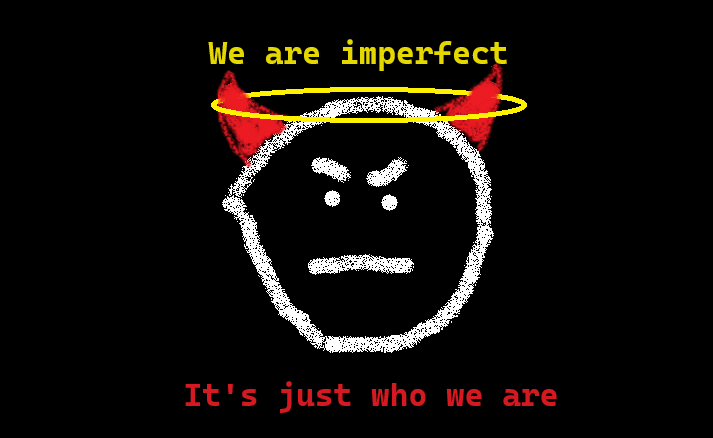
We are imperfect, it’s just who we are. We are the choices we make, the systems we build. Unfortunately, we get lots of things wrong. Indeed, we are everything wrong with the world, but everything right with it too. We are irrational creatures, unaware of our own shortcomings, who can be easily manipulated. However, this is what makes us human, and I believe it is truly empowering to recognise our frailty, because only then can we do something about it, only then can we meaningfully direct our anger.
If you were so bored as to read the diary I have kept for the past 5 years, you would find no salvation hidden within the pages. Instead, what you would see are lists upon lists of rules; no phone upstairs, no phone at bedtime, no phone at meals et cetera. The rules, though written, were never followed as surprising as that sounds. There is the wise saying, “Only an idiot does the same thing over and over again expecting different results”, and I was an idiot for a very long time. Then, “The Social Dilemma” by Tristan Harris was released on Netflix [1]. For the first time, I learnt about phone use minimisation strategies that went further than repeatedly rewriting the same rules over and over again. The strategies included turning off notifications, turning on greyscale, and deleting the problematic apps. However, whilst I found that each new strategy helped for a time, slowly but surely my phone would find its way back into my grasp. For example, as I was no longer receiving notifications, I started checking messaging apps intermittently in case one had come through. Arguably, this left me feeling much worse as often, if not always, I was being greeted by an empty inbox. The rare occasions when a new message had arrived filled me which such dopamine to encourage even more frequent checking. Even now, a sure sign of my current phone health is the speed with which I see and respond to new messages. Whenever I respond near instantly, it’s because I’m checking my phone every few minutes just in case. Usually, and depressingly so, I have lightning response times.
Whilst these strategies weren’t successful, they did open my eyes to a new world of thinking; that of habit formation and control. Everything that I really ought to say about habits has already been expressed so well by a Kurzgesagt video (see the link) that I can neither top nor add anything new to, beyond what is also covered in Atomic Habits, a book by James Clear [2], [3]. Go watch the video now, or else.
There are multiple main takeaways from the video, with a couple more additional ones from the book too, of course. Firstly, make it as easy as possible to perform good habits and as difficult as possible to perform bad ones. The strategies given in The Social Dilemma are examples of barriers that can be put in place to make performing bad habits difficult. Secondly, to become a habit, an action must stick. Whilst I put up barriers to using my phone, they all eventually became redundant because I continued using it regardless. My bad habits simply adapted. Habit formation literally rewires the brain and this process takes time.
Finally, habit execution relies on environmental context and cues. This is because we are lazy. Rather than thinking about what tasks to perform, we’d prefer to be on autopilot. Interestingly however, when we’re placed in a new environment, we are forced to formulate and decide what actions we should take because we cannot rely on autopilot. In these moments, we are flexible to choose better habits. A great example of a habit built on a new environmental cue was when I realised that in a certain bathroom in university I would wash my hands with an unmatched vigour and attentiveness (that is not to say that I don’t always wash my hands, but more to erm suggest that it was less of an active decision and instead an ingrained action in said bathroom). It wasn’t an effort, I just did it. Examples of environmental changes can be moving homes, jobs, schools, travelling, or even new relationships. We need that spark to enable our change because, without it, we face the struggle of experiencing the same cues that lead to the same bad habits. For many years, I had a particularly bad habit that I just could not get rid of. Fortunately, I knew about the opportunities to create new habits brought about by changes in environment. In the space of a month, I did a lot of travel and slept in 6 different living spaces. In each one, I could redefine my actions much easier than I could change my status quo. This enabled me to break my habit for 30 days, meaning it was so much easier to keep going even further. I have kept my new, better habit ever since.
But where does this leave us in our fight to make the world a better place? Well, if an individual can be influenced by environmental cues into forming habits, and if many people experience the same environmental cues, then surely societies are as afflicted by habits, both good and bad, as the individual. And like an individual’s habits, those of a society are equally hard to change, thus becoming locked-in. I first came across the concept of lock-in when reading “What We Owe The Future” by Will MacAskill [4]. His main concern surrounded how the actions we take today coupled with the advent of AI could lock-in values and behaviours for a very long time. Rather than focus on the longtermist view of that book, I became interested in past actions that had locked-in institutions and behaviours in our current society that I viewed as destructive but frustratingly resistant to change. There are a lot of these and they usually stem from the same source … unfettered capitalism. Why is this the case? Well, our system is a capitalist one, and thus systemic faults, inequalities, and injustices are justifiably attributable to capitalism.
I’ll admit that this is the best time to be alive for the average person in the world in part thanks to capitalism [5]. Lots of progress has occurred rapidly in terms of life expectancy, standard of living, educational attainment, healthcare, equality and so on. Of course, it is worth being appreciative of what we have and how we got here. However, such fast changes have led to problems perhaps impossible to have predicted that are now, arguably, locked in. We got the ability to know everything, everywhere, all at once, but now we cannot survive without our phones, and have been transformed into products rather than users. We were encouraged to consume and consume we did, with our desire for energy only being satiated by fossil fuels that are now impossible to ditch and are causing the climate crisis. We got abundant housing, not that we still have it, but the middle class suburban lifestyle that was promoted can only exist in an expanding economy and has led to behaviours that are devasting to the environment (fuck cars). We got social welfare programmes and pensions, but pensions were based on growing populations and economies in perpetuity, today’s taxes covering today’s pensions. Not only has capitalism locked in behaviours that are detrimental to our health and our planet, it has locked in itself. Growth has become a necessity, our social progress coming at a great cost. Can the rot at the core be removed without killing the host?
Well, can it? Perhaps an answer to solving societal lock-in (or society’s bad habits), can be found in the same way the individual solves theirs. Atomic Habits goes into the nitty gritty of how one can design their surroundings to enable good habits. However, as we have seen, habits and habit formation don’t just affect the individual in their home on their phone, though importantly, unlike at home, we are not the only ones designing our surroundings. Behavioural economics/psychology looks at how we are influenced to act in numerous ways on a daily basis. There are two books from this field that I want to recommend. Thinking, Fast and Slow by Daniel Kahneman is basically the beginners guide to this topic and from it we can learn that humans are irrational, biased creatures who are easily manipulated [6]. Nudge (The Final Edition) by Richard H. Thaler and Cass R. Sunstein delves more deeply into the decision making process and how its design and presentation influence our choices, what they describe as nudges [7]. Examples of choices that can be altered/nudged are vast and varied; basically every choice you face in the world has been designed in some way. These choices could be small and repetitive leading to habit formation, or their could be large and life changing like who we vote for. There are many different examples of design that play into nudges, with the main one being the same as that of habit formation: make it easy. Nudging can feed into our laziness, meaning that altering the default option presented to us is sometimes equivalent to choosing the option for us.
Nudges are neutral, but design choices must be made, and they will influence our behaviour no matter what. There are many examples of nudging for good, like increasing saving rates and organ donations. Nudges in the right direction may help combat societal lock-in, they may also contribute towards it… Irrespective, it is very important to be aware of the power of design to manipulate us because major corporations are aware of their ability to nudge. When you get a notification on your phone, you are being nudged. Similarly, when they introduced infinite scroll they removed the nudges telling you to turn off your phone. In the tech sphere, this form of nudging is known as hacking. Nudging isn’t just deployed to encourage social media use. Do you really think advertisers and marketers refrain from nudging? It is the only thing they do. Nudging doesn’t just have profound implications for the individual, it can change society for the better or for the worse.
I’m not against nudging, I think it can be a really useful tool when it comes to overcoming societal lock-in and combating problems like climate change. However, we need to acknowledge and be aware of our fallibility as both individuals and society. We also must be aware of bad actors who seek to exploit our weaknesses. With the advent of Big Data and AI, we are more vulnerable than ever. Why do we buy what we buy? Are our preferences even our own? Can we know we are being manipulated? Corporations don’t give up profits lightly, so we must force them to stop nudging nefariously. They can use Big Data and AI to offer up personalised nudges in real time with feedback on efficacy making each iteration more manipulative than the last. If we’re not angry now, we may not be given the chance to be so in the future. My preferences are my own. As is my data. I reject the idea that because new tools exist they should be legal with little regulation. No one has the right to change me without my consent.
Finally, nudges as a solution to lock-in are similar to 80,000 Hours as a solution to meritocracy. They play within the system. There’s also competing evidence on the efficacy of nudges to actually bring about changes in behaviour[8]. To answer my earlier question of whether lock-in can be addressed without quote unquote “killing the host” (i.e drastically altering society), I’m doubtful. Yes, maybe incremental changes can be made, and nudges can be part of that effort, but maybe to address our most pressing societal challenges we need to change the rules of the game. At the end of the day, changes in environmental context and cues are needed to enable individuals to successfully change their habits, why should it be any different for society? These changes will be painful, if giving up bad things were easier, a whole sector of lifestyle influencers would be out of the job. The question becomes: are society’s biggest problems worth the hassle?
[1] The Social Dilemma website actually has a range of useful resources and suggested actions that can be taken so definitely check it out!
[2] “Change Your Life – One Tiny Step at a Time”, Kurzgesagt.
[3] “Atomic Habits”, James Clear.
[4] “What We Owe The Future”, Will MacAskill.
[5] “Enlightenment Now”, Steven Pinker.
alternatively, watch Hans Rosling’s Ted Talk, “The best stats you’ve ever seen”
Both describe how life on Earth has improved dramatically in the last couple of centuries.
[6] “Thinking, Fast and Slow”, Daniel Kahneman.
[7] “Nudge – The Final Edition”, Richard H. Thaler, Cass R. Sunstein.
[8] “No evidence for nudging after adjusting for publication bias”, Maximillan Maier et al.
Not that I’m convinced one way or the other, but out of the interest of fairness it is worth noting that the power of nudges is limited and contested. I guess I use nudges in two competing senses here. One is the specific definition of nudging as laid out in Nudge. The second is a more broader concept of manipulation that combines nudging with big data and AI to achieve terrifying results.
 The Angry Generation
Leave a comment